Poems by Li Po & Tu Fu
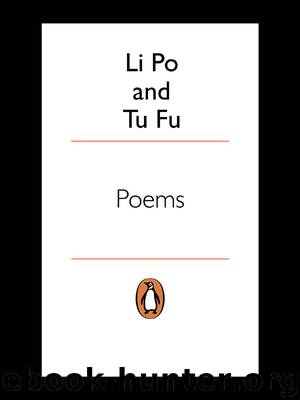
Author:Li Po & Tu Fu
Language: eng
Format: epub
ISBN: 9780141915258
Publisher: Penguin Books Ltd
Published: 2013-04-07T16:00:00+00:00
The East Ranges or East Mountain is in Chekiang province which at this date was called Yüeh; where the great Duke Hsieh An, A.D. 320–85, had lived in his youth and which he always loved. Hsieh An, with this love for his own countryside as well as for scholarship, but going to the aid of the nation in time of need, when he was responsible for a decisive victory over barbarian invaders, was the favourite Chinese type of hero. A story characteristic of him was that he was playing chess (wei-ch’i, usually known in the West by its Japanese name of go) when the news of the victory, won by his younger brother and a nephew commanding in the field under his directions, was brought to him; he glanced at the message, and went on with the game. Asked what it had contained, he said, ‘Only that my boys have beaten the enemy’; but gave way to rejoicing when the game was over.
There is a legend, not apparently recorded until centuries after Li Po’s own time, that this Duke recruited the beautiful dancing girls for his banquets from ‘a rose grotto’, as if they were really fairies, near his home in the East Ranges; but it seems at least possible that, rather than Li Po referring to this legend here, the legend might have arisen as an interpretation of this poem. ‘Roses’ are never mentioned in Chinese poetry of this date or earlier, so far as I can find, nor indeed much before recent Western influence; but this is one of four references to them in Li Po’s poems: two of the others being to roses on a wall outside a window, and one to them growing on a rocky path; all of which seems strangely Western and un-Chinese, Chinese poetry having none of our symbolism of the rose in its tradition.
The origin of this symbolism, though very old in Greek poetry, seems to be Persian; the Greek name for the flower, from which our own comes through Latin, is certainly Persian in origin as well as other names in other languages. (The Chinese name looks as if it must be a loanword, too, but from what language is unknown to me.) It seems, therefore, that this poem of Li Po’s, and his others mentioning roses, are among the rare instances where one can say there is something non-Chinese from the origins of his family, and his own birthplace, in the Far West.
The poem has been responsible for other problems in Li Po’s works, such as a one-time belief that his own place of origin was the East Ranges (though he does not in fact say ‘my’ in the original, except by implication). The Duke Hsieh, too, most often mentioned in his works is not this one but his favourite poet, and one of the great pioneers of ‘nature poetry’ in Chinese – Duke Hsieh Ling-yün who lived in the fourth and fifth centuries and was a notable eccentric, also associated with Yüeh by Li Po; he will be met again in a later poem.
Download
This site does not store any files on its server. We only index and link to content provided by other sites. Please contact the content providers to delete copyright contents if any and email us, we'll remove relevant links or contents immediately.
The Universe of Us by Lang Leav(15090)
The Sun and Her Flowers by Rupi Kaur(14533)
Adultolescence by Gabbie Hanna(8937)
Whiskey Words & a Shovel II by r.h. Sin(8028)
Love Her Wild by Atticus(7767)
Smoke & Mirrors by Michael Faudet(6201)
Wiseguy by Nicholas Pileggi(5805)
The Princess Saves Herself in This One by Amanda Lovelace(4988)
Love & Misadventure by Lang Leav(4857)
Memories by Lang Leav(4810)
Milk and Honey by Rupi Kaur(4757)
Bluets by Maggie Nelson(4576)
Too Much and Not the Mood by Durga Chew-Bose(4362)
Pillow Thoughts by Courtney Peppernell(4294)
Good morning to Goodnight by Eleni Kaur(4242)
The Poetry of Pablo Neruda by Pablo Neruda(4122)
Algedonic by r.h. Sin(4072)
HER II by Pierre Alex Jeanty(3619)
Stuff I've Been Feeling Lately by Alicia Cook(3464)
